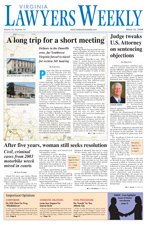
A former bankruptcy attorney was sentenced yesterday to a year and a day in prison for conspiracy to commit bank fraud.
Leslie W. Lickstein, 54, of Fairfax, was accused of preparing a false settlement statement in the sale of a property in Great Falls in July 2002.
As a result, Lehman Brothers Bank made a multimillion dollar home mortgage loan to a home buyer who was not creditworthy. The loan went into default, and the bank sold the property at a loss of $1.1 million. Lickstein was ordered to pay that amount in restitution.
Chuck Rosenberg, U.S. attorney for the Eastern District of Virginia, identified Lickstein as the first president of the Northern Virginia Bankruptcy Bar Association.
Lickstein’s license to practice law was suspended for five years in 2004 by the U.S. Bankruptcy Court in Alexandria and by the Virginia State Bar. He was found to have failed to disclose to the court a fact necessary to avoid assisting in a criminal or fraudulent act.
Showing posts with label bankruptcy. Show all posts
Showing posts with label bankruptcy. Show all posts
Friday, August 31, 2007


Thursday, June 7, 2007
So you want fries with that?
There is a legal story that's been floating around the Internet that is worth pulling to ground and blogging about.
Last month a lawyer from a big firm in Chicago was handling a case in federal bankruptcy court in Miami. Lawyer is head of the bankruptcy section of said big firm.
The judge holds an emergency hearing. As reported in the court transcript posted by the legal blog Above the Law, said lawyer was not the most deferential to the judge. Judge seemed to be wanting to do something the lawyer didn’t like, so the lawyer told her, “I suggest to you with respect, Your Honor, that you’re a few French fries short of a Happy Meal in terms of what’s likely to take place.”
First, anytime you see someone preface a remark to you with the phrase, “with respect,” watch out. You're about to do a turn as Rodney Dangerfield.
Second, Ronald McDonald is not recognized as much of a legal authority. He is, after all, a clown.
And third, if you insult a judge in open court, you do so at your peril.
Needless to say, the judge at whom the Happy Meal remark was aimed was not so happy. She issued a show cause to the lawyer, scheduling a hearing on why he shouldn’t be suspended from practicing in her court and have his pro hac vice admission revoked.
Above the Law broke the story; the Daily Business Review provides an update on the fallout for the lawyer and his firm. Among other developments, the client is no longer his client.
The show cause hearing is set for June 25. Stay tuned.
Thursday, May 3, 2007
Judge rejects ‘deepening insolvency’ theory
In case you’ve been waiting for a Virginia court to weigh in on the theory of “deepening insolvency,” that time has come.
The theory is a way of holding corporate directors liable for operating a financially strapped company in a way that only digs a deeper hole – penalizing them for not knowing when to quit.
“Deepening insolvency” has drawn a fair amount of academic debate since it first cropped up in the early 1980s, but the theory has been on the wane since a Delaware court rejected it last year.
U.S. Bankruptcy Judge Kevin Huennekens threw out the claim in a new case, In re James River Coal Co. (VLW 007-4-003). In JRCC, a coal company and its 21 subsidiaries sought to reorganize under Chapter 11. The trustee of a liquidating trust sued First Reserve, an entity that included major shareholders of the coal company and the managing general partner of the shareholder funds.
The trustee claimed that First Reserve and its directors, “by virtue of their overreaching, domination and control” over the debtors’ businesses, fraudulently or negligently “prolonged the corporation’s existence for more than three years.”
Huennekens said that application of the theory “would fundamentally transform Virginia law,” which does not require a financially challenged company to abruptly wind up its business and liquidate its assets.
“Simply because a business may be failing does not make the directors personally responsible for insuring the success of the business strategies they decide to pursue,” the bankruptcy judge said.
Subscribe to:
Posts (Atom)